Every on-site service contract sounds the same on paper. Fast response. Expert technicians. 24/7 support. You don’t find out what those words actually mean until the machine stops on the morning you need it most — and by then you’ve already signed.
The difference isn’t in the language. It’s in whether on-site service means a real person driving to your office today, or a ticket entering a queue somewhere three time zones away.
What on-site service usually means now
IThe industry has quietly redefined the word. For a lot of national providers, support means a phone tree, a chat window, and a remote session where someone asks you to power-cycle the device and read them the error code off the panel. Which is fine — until the problem is a fuser, a feed roller, a jam sensor, or a finisher that’s out of alignment. None of those get fixed over a screen share.
At that point the call becomes a dispatch request. The dispatch becomes a scheduling window. The scheduling window becomes a subcontractor who has never seen your building. They diagnose it, order the part — and then, often, somebody else entirely comes back to fit it. That’s not one service event. That’s four strangers and three re-explanations.
The number nobody quotes you
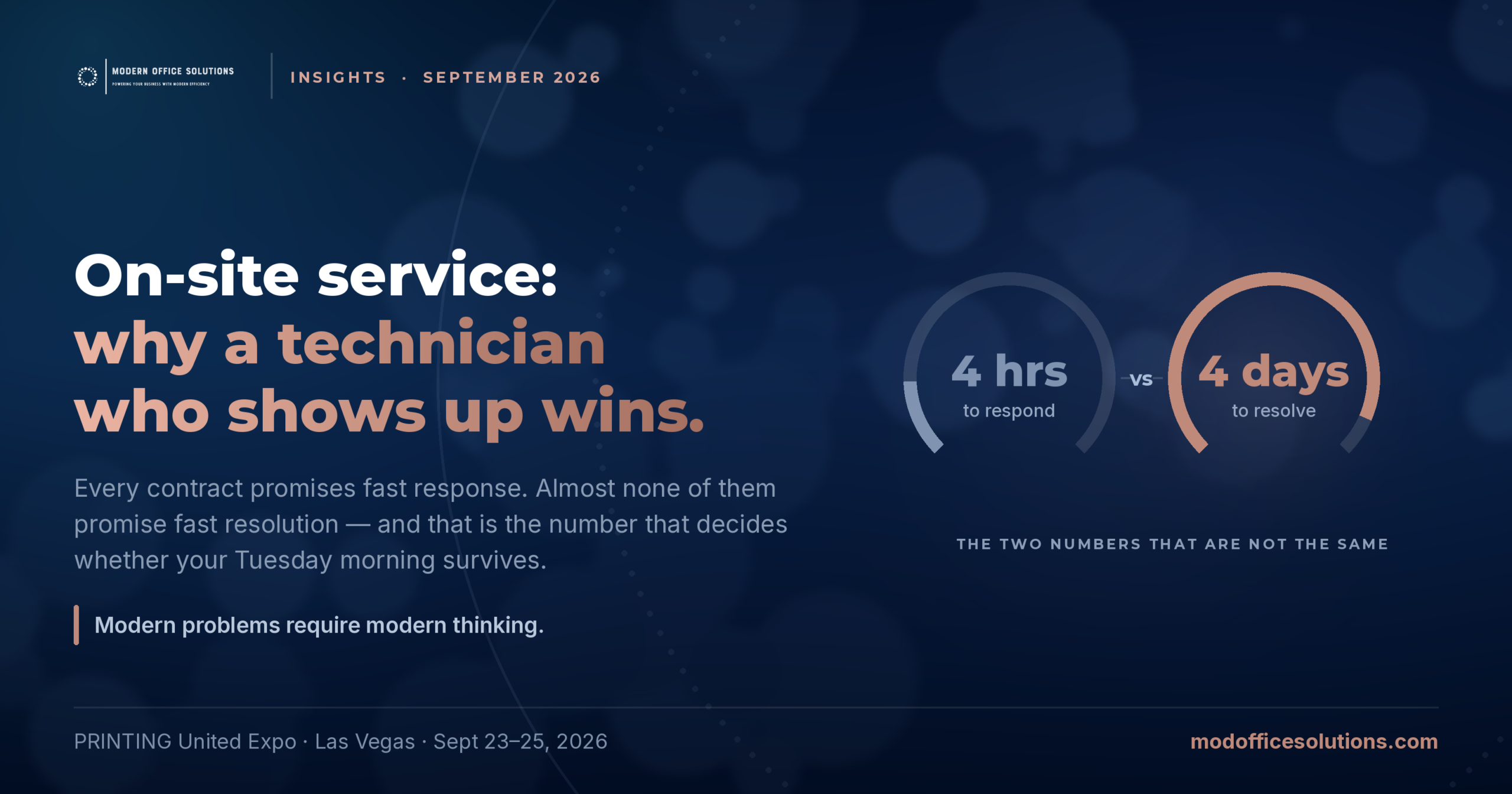
Providers love to quote response time — how fast someone answers. That’s the easy metric, and it’s the wrong one. The number that actually affects your business is resolution time: how long from the moment the machine stopped to the moment your team is working again.
A four-hour response and a four-day resolution are a very common pairing, and it looks great in a quarterly report. Ask any prospective provider for both numbers. Ask what percentage of calls are fixed on the first visit. If they can’t answer, that’s the answer.
Four questions worth asking before you sign
- Where is the nearest technician physically based? Not the call center — the van. Miles matter more than marketing.
- Who comes back with the part? Parts take time at every provider — anyone who tells you otherwise is selling. The real question is whether the tech who diagnosed it is the one who returns to fit it, or whoever happens to be free.
- Who actually shows up — your employee or a subcontractor? Subcontracted service is why the person at your door has never seen your equipment before.
- How many different people will touch one repair? Count them: the person who answers, the person who dispatches, the person who diagnoses, the person who returns. Every handoff is a place where your problem gets re-explained from scratch.
Why local is a structural advantage, not a slogan
This is the part that gets dismissed as small-company sentiment, and it shouldn’t be. A local team accumulates something a national dispatch system structurally cannot: memory of your site. They know your building has a freight elevator that needs a key. They know which department runs the heavy jobs at month-end. They know the device by the finance office throws a specific error when the humidity climbs, and they know why.
That knowledge doesn’t live in a ticketing system. It lives in the handful of people who actually service your region. A small local bench isn’t a limitation here — it’s the whole point. When the same few technicians cover the same accounts, the person walking through your door has probably been there before, and every visit starts further along than the last one.
What this looks like at Modern Office Solutions
We cover California with our own technicians — San Diego through the Bay Area. They are MOS employees, not a subcontracted network. If a deal sits outside our territory we’ll sometimes bring in a partner to cover it, and we say so up front rather than letting you discover it when an unfamiliar van pulls up.
We’re also not going to pretend parts are instant. If your machine needs one, our technician diagnoses it on site, orders the right part, and comes back to fit it. What we won’t do is send a different person to finish someone else’s job. One team owns the problem from the first call to the last screw — and our bench in each region is small enough that the tech at your door is likely one you’ve already met.
We also don’t pretend remote support is worthless — it isn’t. A good chunk of what goes wrong genuinely is a driver, a queue, a setting, or a network path, and solving that in ten minutes without anyone driving anywhere is the right answer. The advantage isn’t choosing on-site over remote. It’s having both, and having the judgment to know instantly which one this problem needs.
The show floor and the service call
Later this month the industry gathers at PRINTING United Expo in Las Vegas, and the halls will be full of impressive machines. We’ll be walking them. But a show floor only ever shows you the equipment on its best day, staffed by the people who built it. Choosing the right machine matters too — that’s what last month’s guide to right-sizing your office equipment was about. But the best-specced device in the hall is still only as good as whoever shows up when it stops.
Your Tuesday is the real test. The device that earns its keep isn’t the one with the best spec sheet — it’s the one somebody competent is standing in front of within hours, who owns it until it runs again. That part doesn’t come from the manufacturer. It comes from whoever you chose to service it.
If you’re not sure what your current provider would actually do at 9 a.m. on a Tuesday, we’ll come find out with you. A free on-site service review looks at your equipment, your real response and resolution history, and where the gaps are — no obligation, even if you never change a thing.
Modern problems require modern thinking. And sometimes modern thinking is remembering that someone still has to show up.
→ Book a free equipment check: contact your Modern Office representative.